
Marketing Mix Modelling Computes and Optimises Returns

Marketing mix modelling (MMM) provides a holistic view of effectiveness of your marketing activities, and includes other factors that otherwise stays unaccounted for.

When to Use MMM

Your business has been established for some time and has built substantial goodwill. Even if paid marketing stopped tomorrow, you’d still attract new leads and sales—just fewer than before. To report effectively, you need to show the portion of business outcomes (sales, leads, etc) directly driven by marketing (incremental sales) and calculate returns based on those results. Your marketing spans multiple channels—search, content, performance, referrals, CRM, events, perhaps even TV or radio. Understanding their incremental impact allows you to scale back where returns diminish and invest more where marketing delivers the strongest results.
What MMM Delivers

Marketing mix modelling (MMM) is a statistical method that separates the outcomes that would have occurred anyway (your baseline) from those attributed to marketing activities and external factors. Given enough data, it can also detect when a channel starts delivering diminishing returns.

MMM starts with a list of factors you believe affect outcomes—like spend by channel, seasonality, or competitor activity—and assumptions about how they do so. The system then tests those assumptions against your data and adjusts them until it finds the parameters that best explains what actually happened.

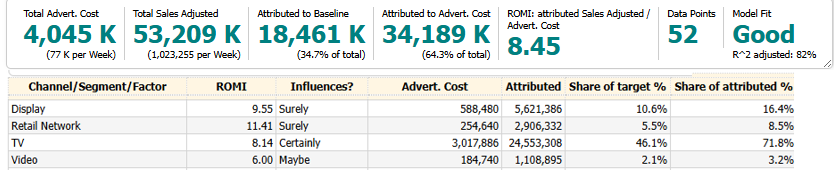
These results translate into business metrics such as return on marketing investment (ROMI) or cost per sale, along with measures of accuracy. Here is a sample dashboard displaying ad spend, total sales (adjusted to seasonality), sales attributed to advertising and ROMI - overall and by channel: Other useful outputs include diminishing returns charts, channel contributions, ROMI over time.

Behind the numbers, there is a mathematical formula connecting outcomes with marketing effort. With sufficient accuracy and confidence in the model, it can be used to forecast future results based on planned activity, or even optimise activity to achieve specific outcomes.

The challenges

The quality of MMM depends on using the right data and assumptions. Missing variables, inconsistent metrics, or mismatched levels of detail can lead to unreliable results. Reliable measurement requires consistent, retrospective data—by date, region, and customer segment —covering spend, outcomes, and influencing factors over at least 12–24 months.

Because data structures, regions, and segment definitions evolve, older data often loses consistency. When that happens, several months may be needed to rebuild a usable dataset.

This is why planning your data capture early is crucial, and the best way to plan is to attempt modelling with the data you currently have. This will quickly reveal what’s missing: which additional metrics and at what level of detail need to be collected, how regions and segments should be defined, etc.


© sys2biz Pty Limited, 2020 | Privacy Policy | LinkedIn | Facebook