Measuring Long Customer Journeys - Funnel Progression

This approach to measuring long and complex customer journeys is based on understanding how people move through the funnel and connecting early engagement signals with later outcomes. It does not involve tracking individuals end-to-end.

Setting the Stages

We begin by understanding how your customers make decisions:

  • Is there a defined funnel? If not - the Time Profile model is more suitable.
  • What is the journey duration?
  • Are there seasonal patterns or specific triggers that influence behaviour?

We then define the metrics that describe each stage of the funnel and what constitutes success. These range from broad indicators such as brand searches to engaged visitors, expressions of interest, brochure downloads, call centre contacts, newsletter subscriptions, and conversions.

Understanding How Prospects Move between the Stages.

We use two main tools: clickstream tracking and modelling. The clickstream tracker explores multi-step, multi-visit digital journey to answer questions like:

  • How do visitors arrive at a particular touchpoint / micro-conversion?
  • Which media, campaign, content brought them to your site?
  • What other pages did they visit before and after each touchpoint?
  • What paths do visitors take from touchpoint A to touchpoint B? how long does it take? How many steps in between?

Exploring digital behaviour at detailed level helps clarifying segmentation, funnel stages definition, and selecting descriptive metrics.
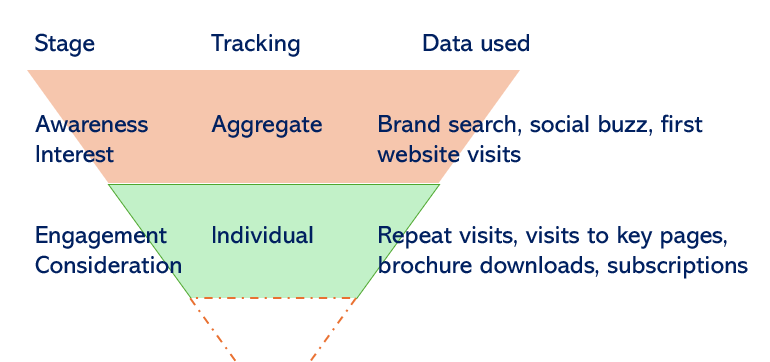
For the later stages of the funnel – forms, quotes, applications – direct tracking via website and CRM plus touch attribution quickly provides rich dataset suitable for performance tuning and forecasting.

For the early stages – awareness, interest – many journeys cannot be digitally tracked due to identity gaps and offline steps, so progression of customer cohorts from one stage to the next over time is done by mathematical modelling. However, the models are informed by the behavioural patterns researched with clickstream analysis.

Creating End-to-End Models

Both early- and late-stage insights contribute to one coherent understanding of how people move through the funnel - an end-to-end model of the customer journey that links engagement leads to later outcomes.

For example, a model can show how a display campaign run today would generate increased brand searches and website visits within weeks and subsequent development of interest over several months - manifested in repeat visits and brochure downloads, and forecast the time range when these visitors will start converting into leads. Knowing the expected lag and conversion ratios between the stages, you can plan your campaigns to achieve desired result and adjust campaigns and/or content early when interim stage indicators show underperformance.

What is required to make this possible is the combination of both business expertise and analytical judgment, and appropriate tools to create integrated view, facilitate analysis, and repeat it on-demand.
This is why we offer Service-and-Software - working with you to understand the business and set up the models and offering a self-service portal for daily tracking and fine-tuning.

© sys2biz Pty Limited, 2020 | Privacy Policy | LinkedIn | Facebook